
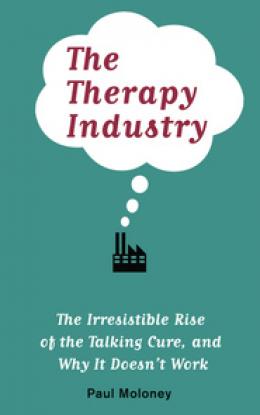
What does a book about therapy have to do with the peace movement?
Psychological difficulties and their treatment are often thought of as a personal and humanitarian issue, as apolitical. Paul Moloney disagrees; he argues that much of the unhappiness treated by therapists is the result of living in relative poverty, powerlessness and inequality in a consumer society.
These problems demand collective social change; yet the disciplines of psychiatry and…

At a time when many people in politics and the peace movement are focussing on the centenary of the start of the First World War, it may be thought inappropriate to bring out a book concerning the re-run 20 years later. Ann Kramer’s book, however, is a salutary reminder, not only of the irony of HG Wells’s 1914 book title (The War that Will End War) but also of the strength of the Second World War pacifist movement that largely had its roots in the struggle against the earlier war.
It is 30…
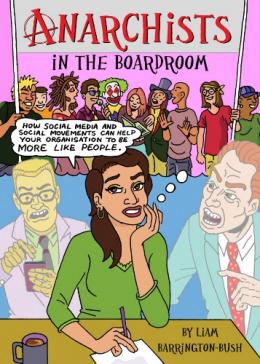
Like the author of this book, I’ve had the experience of working for a large NGO (non-governmental organisation) and, in the process, becoming de-skilled, de-motivated, uncreative and disempowered.
After a couple of years of struggling with hierarchy and unimaginative bureaucracy, I left to do more activism, study for an art degree, and work part-time for a small start-up charity where my skills have been appreciated and nurtured. So naturally I was keen to crack open my copy of this book, and I was well rewarded!
…
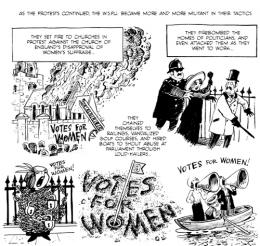
Activism and resistance – both violent and nonviolent – take centre stage in the New Internationalist’s latest comic book (Fight the Power! A visual history of Protest Among the English-Speaking Peoples; 192pp; £9.99). Written by Séan Michael Wilson (Parecomic) and Benjamin Dickson, and illustrated by John Spelling, Adam Parson and the wonderful Hunt Emerson (How to be Rich, Ratz), it covers fourteen separate…
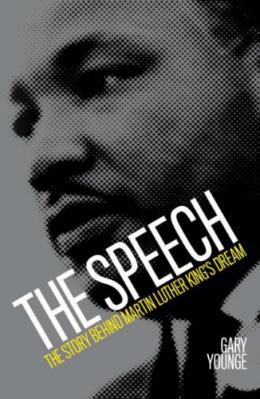
On 28 August 1963, Martin Luther King Jnr delivered his famous ‘I have a dream’ speech on the steps of the Lincoln Memorial in Washington DC to an audience of over 200,000 marchers, calling for economic and racial justice for Black Americans and an end to segregation. Unbeknown to him, the justice department had installed a secret cut-off device in the sound system, so that they could turn off the speakers if they saw fit. Meanwhile, the Pentagon had 19,000 troops on standby.
Two days later, William Sullivan, the FBI’s assistant…

In his latest book on the built environment, Owen Hatherley visits 17 towns and cities across Britain, presenting an architecturally-inflected state of the nation.
Part travelogue, part searing political critique, the book takes the form of a series of ‘urban trawls’, bringing the author to ‘some extremely unlovely places’: the Thames Gateway, Belfast, Birmingham, the City of London (‘the satanic site at the heart of the UK’s malaise’).
On each journey, Hatherley finds a Britain failing in intellect and imagination,…

If you’ve been an activist in the UK for any length of time then it’s likely – whether you know it or not — that you’ve rubbed shoulders with one or more spies. In 15 years of activism, I can think of three definite cases of infiltration of the groups that I’ve been involved with.
There was ‘Rod’, the undercover police officer who infiltrated the WOMBLES (the ‘White Overall Movement Building Liberation Effective Struggles’, a UK anti-capitalist group who adopted some of the tactics of the Italian group Tute Bianche – eds); ‘…
Edward Herman and Noam Chomsky’s 1988 book Manufacturing Consent offered a ‘Propaganda Model’ for analysing our dysfunctional mainstream media system, four of whose ‘five filters’ David Cromwell outlines as: ‘heavy dependence [of corporate media] on advertising revenue; reliance on approved news sources such as governments and business; the threat, and use, of flak by powerful interests to keep the media in line; and an ideological framework that demonises state-designated enemies’. (The fifth filter is corporate ownership of the…

This book offers important insights into US covert military operations over the past decade. While US drone strikes tend to get the headlines, behind the scenes – and perhaps even more lethal – is the work of the Joint Special Operations Command (JSOC) on which much of this book is focused.
In the first 100 pages, Scahill traces the rise of the neocon movement back to Watergate, and then shows how the neocons, through US defense secretary…

Since creating the post-religious Church of Stop Shopping in 1999, the Reverend Billy has held services in churches, community centres, forests, fields, parking lots, shopping malls and – above all – inside brand-name stores across the US and Europe, preaching against consumerism, and for economic and ecological justice.
The creation of actor Bill Talen, the Reverend Billy is a televangelist-style preacher with Elvis hair whose…
This book explores the revolutionary politics and activism that sprang up in Argentina in December 2001. With the state collapsing in the midst of a severe economic crisis, sections of the population responded by organising demonstrations and neighbourhood assemblies.
In the months and years following this societal rupture, workers began to occupy their workplaces and alternative media outlets and extensive barter networks were…
Do you give a damn about the future of democracy? Read this book.
Do you want tools to help our species to respond to climate change with the speed and breadth it needs? Read this book (although it barely mentions climate change at all).
Do you need to restore your faith in the ability of academics to have important ideas and insights and express them in real English? Read this book.
Kathleen Blee, an American sociologist, spent four years attending the meetings of new groups that sprang up in Pittsburgh between 2003…
While ‘[m]any people believe that America’s addiction to automobiles is a cultural problem’, in reality – as cartoonist Andy Singer explains in this wonderful ‘pictographic examination’ of the American transport system – the country’s ‘automobile addiction has more to do with politics, government agencies, and the [US] tax structure’.
Indeed, in the 1920s, most North Americans lived in cities, many of which had great public transit and inter-urban rail systems, leading the president of General Motors, Alfred Sloan, to note that – as…
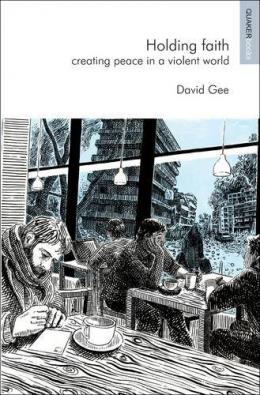
This accessible book – exploring what it means to make a commitment to peace in a violent world – could appeal equally to someone with an interest in peace who may be wishing to find ways of putting this into action, as to a seasoned activist. As much to an agnostic as a person of faith. Wherever you are internally, that is where it takes hold and shakes you.
I even lost my copy, preferring perhaps to drift in the ‘pale blue window’ dividing the ‘over there’ of violence from the ‘here and now’ of a comfortable, oppressive reality.…
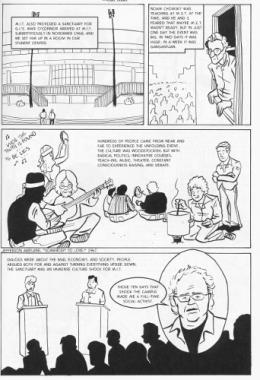
Parecomic: The Story of Michael Albert and Participatory Economics is a clear, thoughtful and compelling introduction to some of the most challenging ideas around, and to an inspiring life of radical construction. After leading revolutionary student activism in the top scientific university in the US, MIT (the sanctuary described above had a huge impact), Michael Albert was the driving force in creating: an important radical…